Click here to sign up for our free daily newsletter
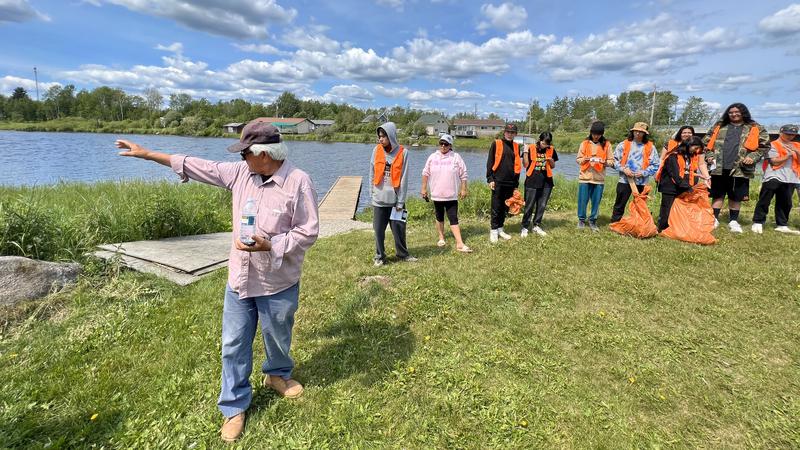
Students get an education on the banks of Nemeiben Lake (Submitted Photo/Devin Bernatchez)
Science Camp

Young science students learn to be stewards of the land during camp experience

Jul 2, 2024 | 5:22 PM

On one side of Nemeiben Lake, eagles are scarce.

As 11 students from La Ronge and Sucker River stood on the shoreline, their teachers asked them why.

“They said, ‘Well, there’s nowhere for them to nest,’” said Lac La Ronge Indian Band Councillor Devin Bernatchez.

Watching climate change in action, the students saw that while one side of the lake was lush with mature trees, the other side had burned.


“It displaces the eagle and they’re unable to nest in their favourite fishing areas, so they have to travel further to get their food.”

This experience took place last weekend during the Traditional Knowledge Science Camp – or the University of Keeweetan: meaning ‘Let’s go back to our ways’ in Cree, put on in partnership with the Prince Albert Grand Council, University of Saskatchewan and Lac La Ronge Indian Band.

The goal of the weekend was to get the students out of the classroom and learn in the field through a mix of western science and traditional knowledge, the latter from four elders from La Ronge, Sucker River and Stanley Mission.

“This camp was designed for high school students 16 and older and we wanted to lay the foundation down on how science is important for youth to get involved in the jobs of today and tomorrow,” he said.

Bringing in professors from the University of Saskatchewan, students were able look at the effects of climate change on the environment – especially the lakes and rivers.

“The ash that falls out of the fire for example harms fish, because they eat the ash,” said Bernatchez.

The heat from forest fires is also warming up the water he said, which is a problem as they require a cooler environment.

“Especially now in the summer, there’s certain species that really need cold water, they go deeper,” said the councillor and science educator.

“We were able to look at the nine species of fish in Nemeiben Lake and examine them,” he added, noting the students were able look to see if they were healthy, dissect them and check organs.

“They were also checking to see if we have a healthy population of fish in Nemeiben Lake, which we do at this time.”

Other areas of study included learning from the elders about traditional knowledge of vegetation, different species of trees (elders showed the students which plants were edible, which were poisonous) and the history and Cree names of the lake.

“A lot of names now on lakes, there’s different island’s names well, there were names three before, locations, different marking points,” he said.

“All those were named in Cree for certain reasons so, there was a lot of history involved too.”

One of the results of climate change that has had an impact on the north has been the introduction of new insects that aren’t indigenous to the area and may be invasive.

“That’s what this science camp was also really based upon was future generations taking part in science and learning to protect their environment so that they can heave a healthy fish population, healthy water and at the end of the day, a healthy environment to live in.”

Back under that eagles’ nest, students learned something else – everything in nature has a role to play.

As the young scientists observed their field, on the ground around the base of the tree, they saw bone remnants of goose, beaver and fish.

“Those little critters and the stuff on the land, they depend on the eagle to bring that stuff from the water onto the land,” Bernatchez said.

“There was an interconnectedness that we showed them too from the top predator – he leaves and feeds a lot of the other animals.”

Meanwhile, Bernatchez said they plan on expanding the camp next year.

“At the end of the day, we’re wanting our teachers and our schools up here to know that the classroom setting isn’t always the best place to teach students about science or math or whatever,” he said.

“Take ‘em outside. That kind of learning is sometimes best suited for students.”

julia.lovettsquires@pattisonmedia.com

On X: jls194864