Click here to sign up for our free daily newsletter
(Image Credit: File photo/ paNOW Staff)
Back to School

National coaltion calls on Sask. government to fork over more money for school lunch programs

Sep 2, 2026 | 4:07 PM

With children heading back to school this week, parents are once again busy assembling lunches. But not every child will have the same experience or range of healthy options.

The pressure to provide students with a meal then falls on the school, which gets its funding from the provincial government.

According to a report from the Coalition for Healthy School Food, and based on data from 2023, Saskatchewan came last out of all the provinces with respect to government investment in school lunch programs. The contribution per meal was equivalent to only 3 cents. Nova Scotia, which recently rolled out a new program, was the top investor amongst the provinces and pays out $3.30 per student each day.

Debbie Field, National Coordinator for the non-profit coalition, said since the report there has been a two-to-three per cent increase every year tied to annual inflation, but no significant increase from Saskatchewan in contributions compared to most of the other provinces and territories.

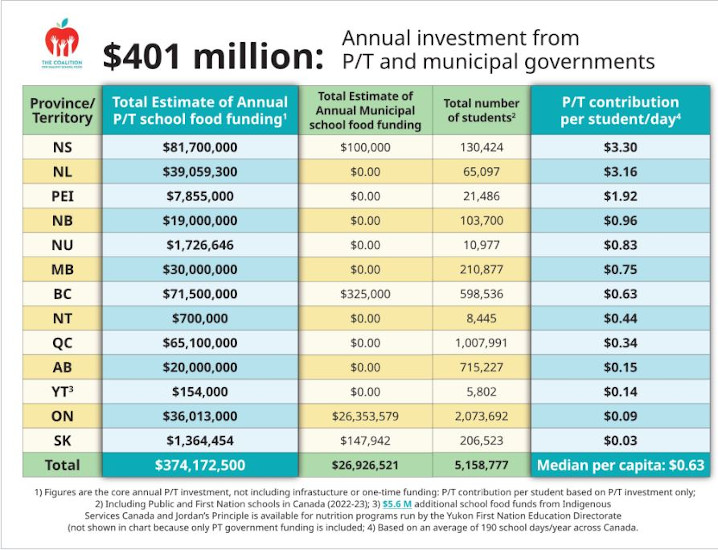
She cited a report done by the Sask. School Boards Association, which talked to principals from across the province.

“And the principals said where there was a good school lunch program, not just attendance and learning were better , but they really felt mental health amongst the kids was better,” she said.


(Image Credit: Coalition for Healthy School Food.)

In March of last year, the provincial and federal governments signed a $15.8 million, three-year agreement under Canada’s National School Food Program.

The program aims to provide meals to as many as 400,000 students across the country over five years, thanks to a $1 billion investment.

Field also acknowledged there are some really great grassroots programs happening in the community.

“But this is one of those things where the provincial government needs to be involved,” she said. “I know we are all looking at budget cuts and we are all looking at the complexities facing governments, but I can say for sure that I don’t think there is a single investment that is more important to the health and well-being of the future generation.”

According to a statement provided by the Ministry of Education, Saskatchewan Child Nutrition Program funding has provided healthy meals to Saskatchewan students for the past 36 years, with a budget of $2.8 million in 2026-27.

Incremental funding increases have grown the program budget by more than 21 per cent since 2017-18.

“The new federal program builds on the work being done through the Saskatchewan Child Nutrition Program. The three-year National School Food Program agreement between the Governments of Saskatchewan and Canada, signed in 2025, provides $15.8 million in federal funding over three years to support school division programs in expanding existing or developing new food programs,” the Ministry stated.

One example of the successful grassroots initiatives is the Feeding our Futures Program, which has run in Prince Albert for the past seven years and involves a partnership between Lake Country Co-op, Lakeland Ford, Lakeland Hyundai, Signature Group, Broda Group, and Conexus Credit Union.

These companies have collectively provided over 400,000 emergency lunches to the students of Prince Albert.

“Their contributions have not only filled empty stomachs but have also fostered a sense of support and unity within our Saskatchewan Rivers community,” the Saskatchewan Rivers School Board said in a statement on their website.

“The impact of this program goes beyond the meals served. It symbolizes the power of collaboration and community spirit.”

nigel.maxwell@pattisonmedia.com

On X: @nigelmaxwell